
What if we told you that great photography isn’t always about what you capture, but how you capture it. By bearing a few classic composition techniques in mind, you can make even the most banal scene look aesthetically pleasing. In this blog post, we’ll be showing you how. Here are 5 composition rules that’ll instantly improve your photography.
1. Symmetry
The first composition rule we’d like to touch on is symmetry. Regardless of where you are or what you’re shooting, framing your subject matter symmetrically will automatically organise it into minimal, harmonious compositions. What is it about symmetry that’s so visually appealing? The truth is, humans are biologically-wired to favour symmetrical objects, faces and scenes. Take advantage of this in your photography for instant crowd-pleasing images.

2. Rule of Thirds
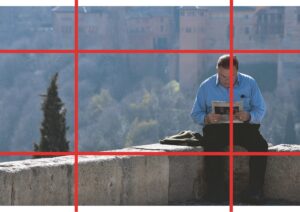
Next up on our list is the ‘rule of thirds’: a guideline which states that a visual composition is most pleasing to the eye when subjects are placed in either the left or right third of an image, leaving the other two-thirds more open (see below). As you can see, the rule of thirds provides breathing room for your subjects by positioning them in relation to their surroundings. As a well-established principle in aesthetics, the rule of thirds is a must-have technique for anyone with a passion for photography.
3. Leading Lines
Composition rules in photography are really a matter of directing the viewer’s attention within the frame. Some rules do this more powerfully than others. Our next composition technique, ‘leading lines’, is one such example of this. Leading lines forcibly orient the viewer toward the most important parts of the frame. They also provide a sense of depth to your images. Pictured below, the leading lines of an underground tube station illustrate the power of this composition rule in-action…

4. Golden Triangle
A list of composition rules wouldn’t be complete without mentioning ‘the golden triangle’. The golden triangle is a very old composition rule and, like symmetry, aims to organise the frame into geometrical harmony. Unlike symmetry, the golden triangle does this through a collision of four triangles, creating two prominent 90° angles that portion out the frame evenly. Bearing these geometric configurations in mind whilst shooting will make you a better photographer—promise.

5. Deep Space
Last up on our list of composition rules to improve your photography, we arrive at ‘deep space photography’ (spacesuit unnecessary). Deep space compositions are in no way exclusive to photography. In fact, this technique is more famously associated with cinema due to Orson Welles’ pioneering use of it in Citizen Kane (1941). There, deep space is employed to ensure the foreground, middleground and background are all in focus at the same time—much like the image below. The result is a tableaux that the viewer can interact with, which makes for a more engaging image. Give it a go next time you’re faced with a wide, open expanse. Good luck!

Why Glover & Howe?
With over 50 years of experience in photographic insurance, we understand how much your camera equipment means to you. That’s why we boast a specialist in-house claims team to ensure that should you need to make a claim, it’s dealt with in full, in a timely and efficient manner. Click here to start calculating your quote.
Protect your photography equipment and have peace of mind with Glover & Howe. If you have any further questions about our specialist photographer insurance, speak to the team about your requirements on 01206 814500.
Recent Comments